

THE ANATOMY
OF MUSIC
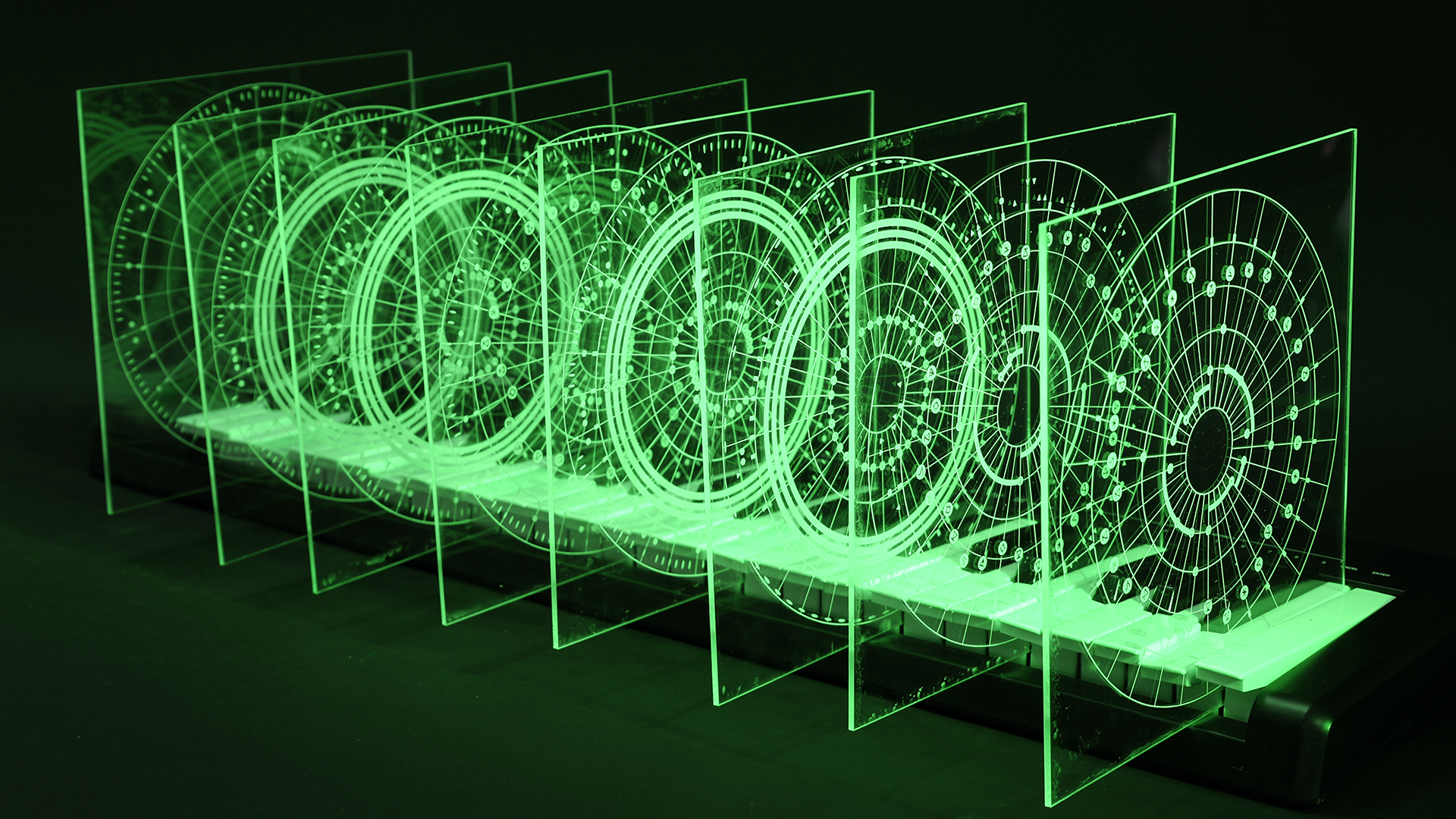
This project explores how music notation can be restructured visually and physically, rather than relying on the traditional five-line staff. Instead of reading music only as a linear sequence of notes, I wanted to represent it as a layered structure that shows harmonic relationships more clearly.
The final outcome consists of eight laser-cut transparent acrylic sheets. Each sheet represents a structural section of a song, such as the intro, verse, chorus, and bridge. When viewed individually, each layer shows the harmonic information for that section. When stacked together, the layers reveal the full composition. The transparency allows the viewer to see how sections relate to one another, creating a physical representation of the song’s structure.
The notation system is built around the circle of fifths. Rather than placing notes on a horizontal staff, pitch is organised radially to reflect harmonic proximity. Notes that are closely related appear closer together in the system. This makes key relationships and modulations easier to understand visually.
NOTATION SCREENS
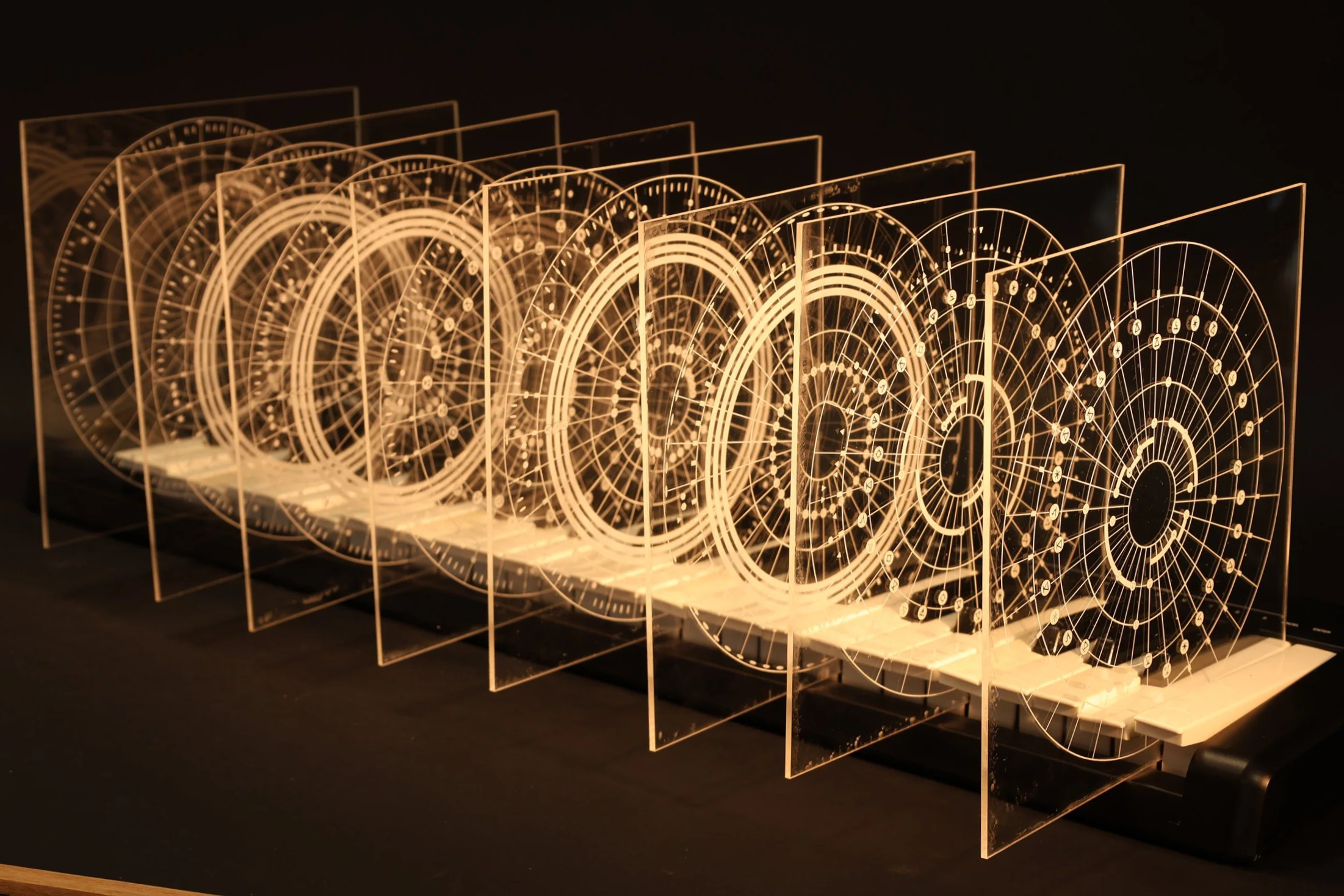
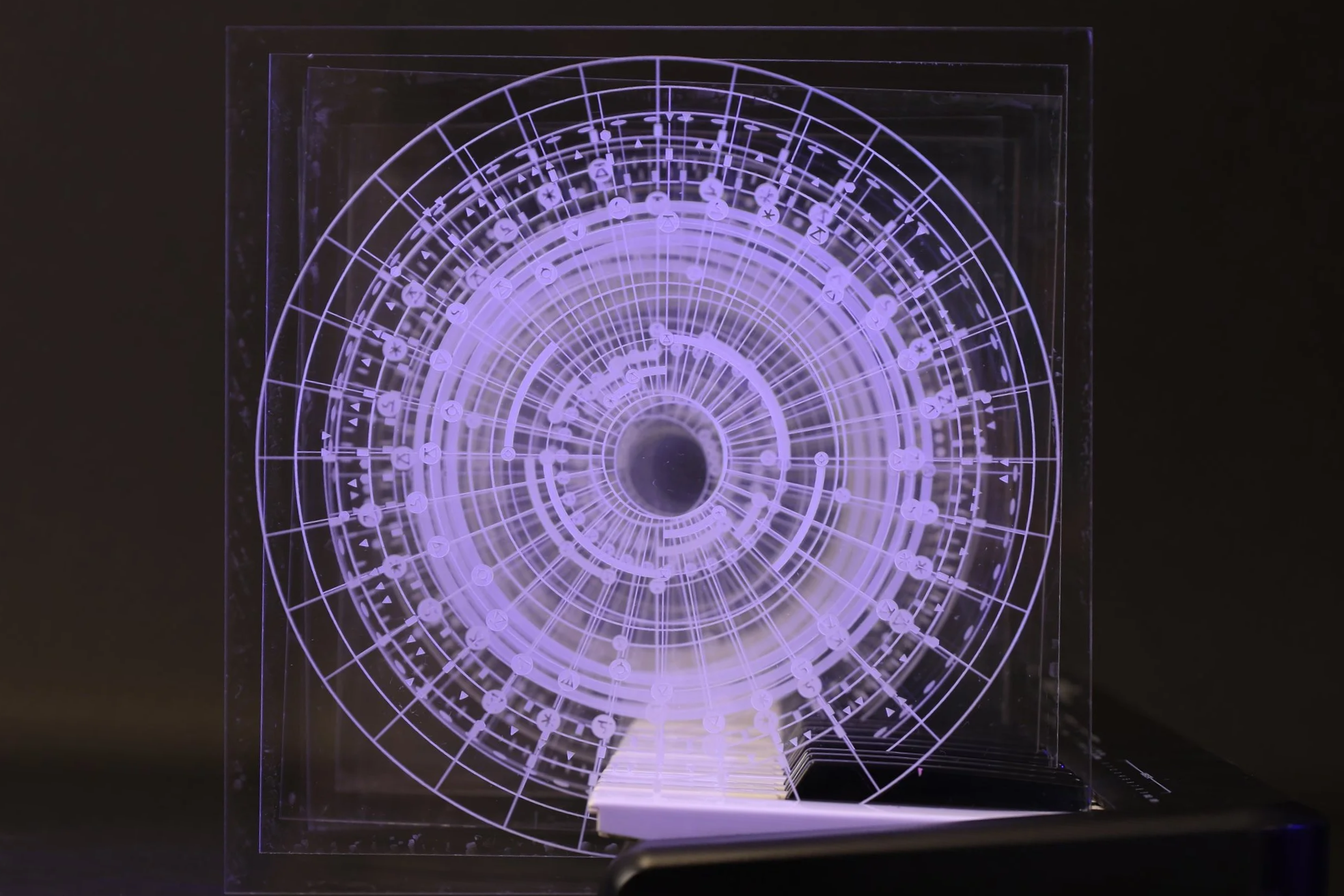
The final outcome consists of the completed circular notation sheets for Sweet Disposition by The Temper Trap. Each full rotation of the circle represents eight bars, reflecting the song’s repeating sectional structure. Notes are positioned spatially according to timing, while their colour and symbol communicate interval identity. By arranging the transcription in a circular format rather than a linear staff, the repetition of the song becomes visually explicit. The sheets function both as readable notation and as a visual artwork, merging structural accuracy with the symbolic language I developed throughout the project.
3D TRANSLATOR
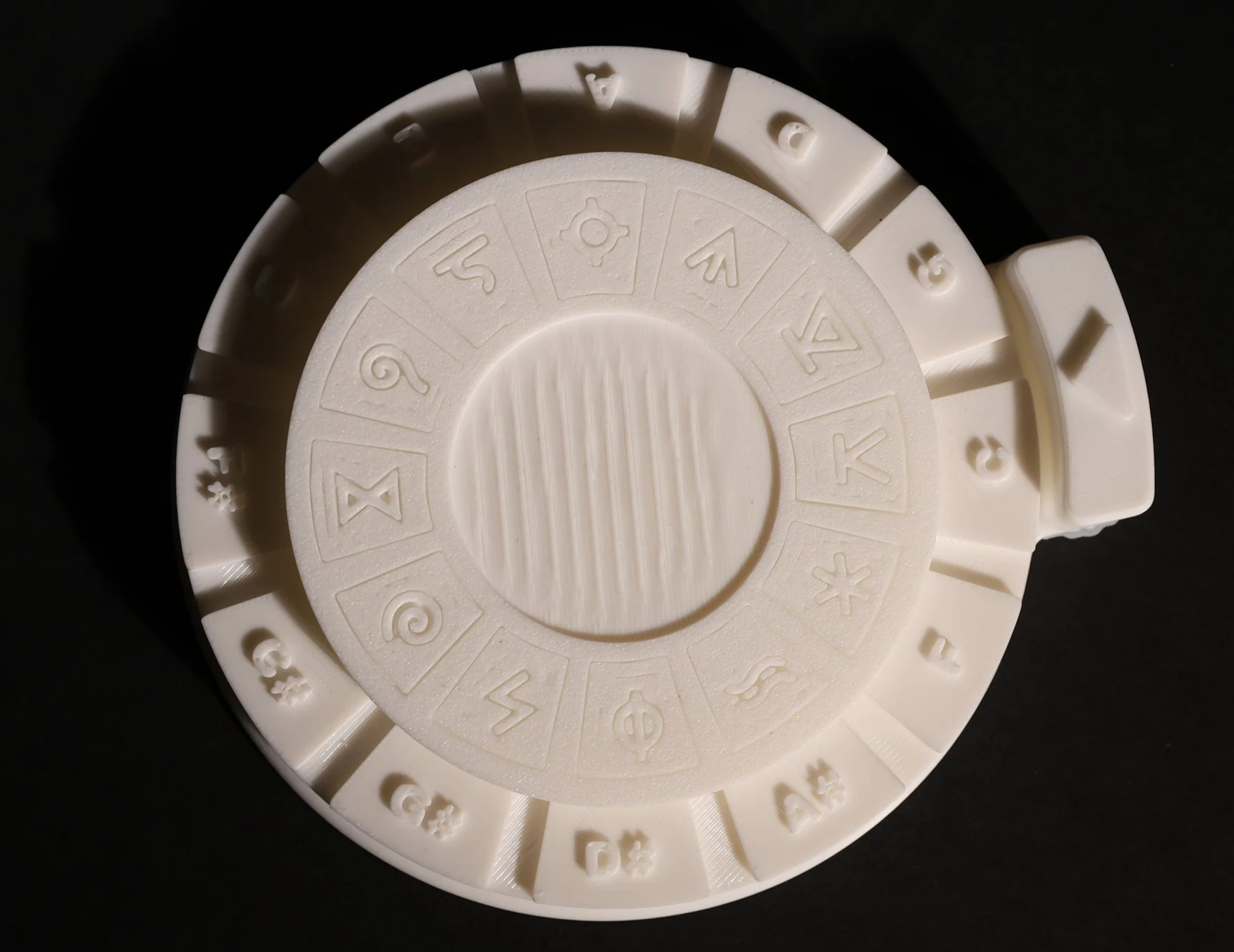
Because my notation system is written entirely in intervals, it functions independently from the original key of a song. While this makes the system flexible and theoretically consistent, I realised that it also creates a barrier for someone trying to read it quickly. To solve this, I designed a rotating translation wheel. My symbols are arranged around the outer ring according to the circle of fifths, allowing them to transition gradually from tonally neutral, to brighter or more harmonically tense, through to darker or more dissonant, and back to neutral. Inside this, a second rotating layer displays standard musical note names arranged in the same circle of fifths order. To use it, the reader simply aligns the root symbol of my system with the key of the song they are playing, and the rest of the scale translates automatically. This makes the system practical rather than purely conceptual, and turns what could have been an abstract idea into a usable tool.
SYMBOLS KEY
Alongside the wheel, I designed a key that explains my symbolic system. Because my notation replaces traditional note heads with elemental symbols tied to colour and interval function, I recognised the importance of clarity. The key presents each symbol alongside its interval number, its tonal quality, and its associated colour family. Major intervals are grouped visually through warm hues and elemental references such as fire and sun, minor intervals are grouped through cooler tones connected to water and ice, and neutral intervals such as the root and fifth are associated with green and earth. This layout allows someone unfamiliar with the system to decode it logically rather than intuitively.
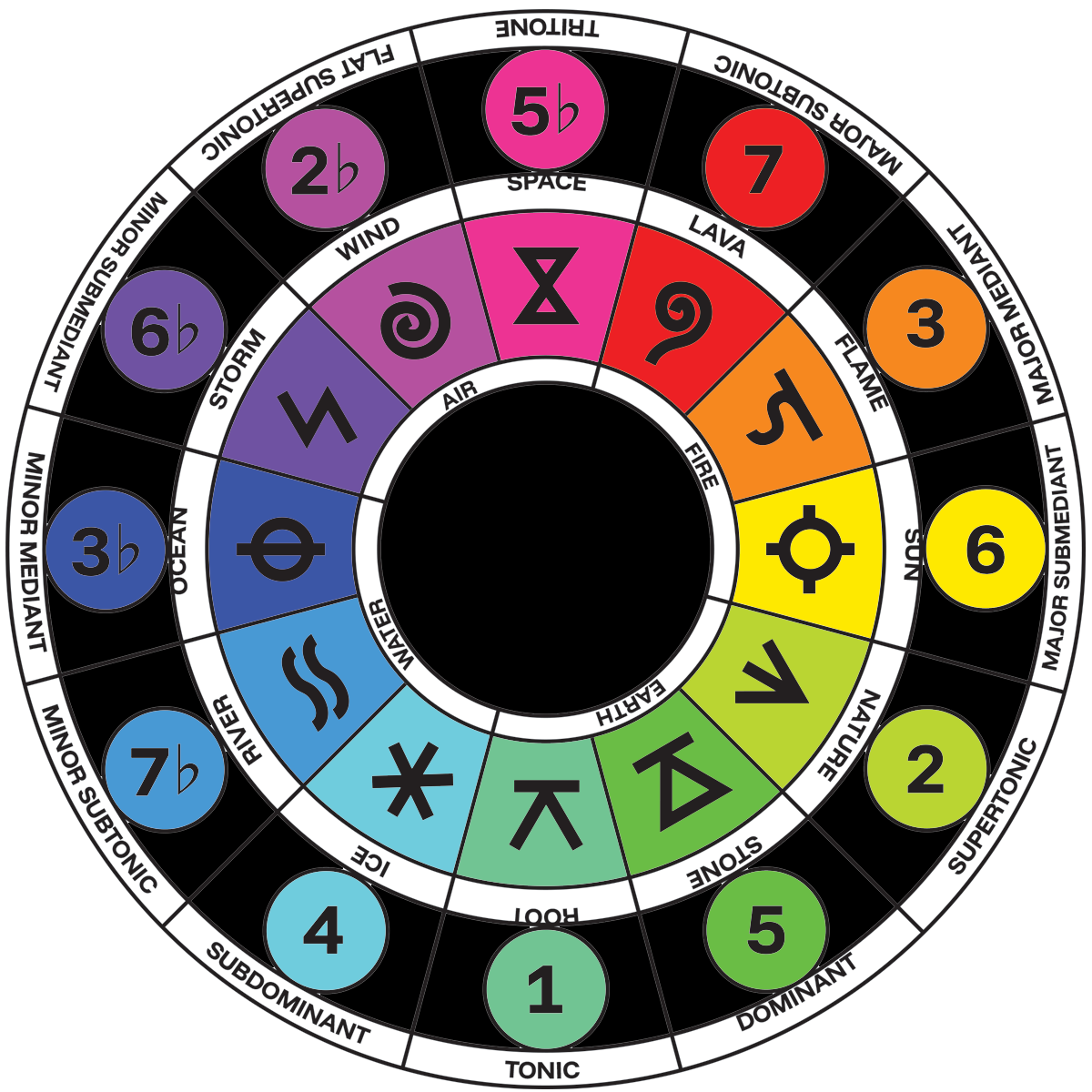
The key also reinforces the conceptual foundation of the project. By clearly organising intervals according to tonal function, it shows that the system is not decorative but structurally reasoned. The visual grouping mirrors harmonic relationships within Western music theory, making it easier to see patterns across scales. In this way, the key acts both as a guide and as evidence of research underpinning the project.
1 ROOT
5 STONE
2 NATURE
6 SUN
3 FIRE
7 LAVA
5b SPACE
2b WIND
6b THUNDER
3b MOON
7b WATER
4 ICE
1 ROOT 5 STONE 2 NATURE 6 SUN 3 FIRE 7 LAVA 5b SPACE 2b WIND 6b THUNDER 3b MOON 7b WATER 4 ICE
PROJECT
DEVELOPMENT
In my spare time outside of university, I began drawing out songs in my own visual language. At first this was purely experimental and done as a hobby, but it gradually became the foundation of the project. I started designing individual symbols for each scale degree, basing them on elemental associations linked to colour. Major intervals were represented by warm colours and connected to elements such as fire and the sun, reinforcing their brightness and tension. Minor intervals were shown in cooler blue tones, associated with water and ice, reflecting their softer or more introspective quality. Neutral notes, particularly the root and the fifth, were represented with green hues and linked to earth, suggesting stability and grounding within the scale.
Initially these symbols were highly illustrative, with detailed elemental drawings, but over time I refined them into simplified graphic forms that could function clearly as notation. Alongside this, I was challenging myself to learn complex drum patterns that were not in 4/4 time. To understand these rhythms, I began sketching them in circular formats, which allowed me to visualise repetition and subdivision more clearly. This experimentation helped me see how circular systems could make irregular rhythmic structures more intuitive, and this directly informed the structural approach of my final outcome.